
- BENCH PRESS
- 1RM
- PERCENTAGES
Bench Press 1RM Calculator
Enter a recent hard set on the bench and get your estimated bench press max, with the percentages, rep maxes and warm-ups to plan your next session. Made for lifters who would rather not grind out a true max just to find their number.
Bench Press 1RM · estimated
98.2kg
≈ 216.4 lb
Consensus of 7 of 7 formulas · 85 kg × 5 reps
Lowest 95.6Highest 101.2 kg
Estimates only. Not medical or coaching advice.
Formula comparison
Seven published formulas convert a submaximal set into a 1RM estimate. They disagree a little, and that is useful: the consensus is the average of the formulas you keep ticked. Use the arrow on any row to see the maths with your own numbers.
| Formula | Estimate | vs. avg (difference from the consensus) | Show calculation |
|---|---|---|---|
| 99.2 kg | +1.0% | ||
Your numbers: Linear and slightly generous at higher reps. The most widely used formula. | |||
| 95.6 kg | −2.6% | ||
Your numbers: Tends to be conservative at low reps and climbs fast beyond 10 reps. | |||
| 99.8 kg | +1.7% | ||
Your numbers: Power-law curve. Gives higher estimates than most formulas at 2–6 reps. | |||
| 95.6 kg | −2.6% | ||
Your numbers: Simple linear model, usually among the lowest estimates. | |||
| 99.1 kg | +0.9% | ||
Your numbers: Exponential model fitted to rep-max data; close to Epley at moderate reps. | |||
| 101.2 kg | +3.0% | ||
Your numbers: Developed from bench press data in trained athletes; usually on the higher side. | |||
| 96.7 kg | −1.5% | ||
Your numbers: Linear in the denominator; behaves much like Brzycki at low reps. | |||
| Consensus (average of ticked) | 98.2 kg | ±2.8% | |
The formulas agree within 5.6% for this set.
1RM percentage table
Working weights from 50% to 100% of your estimated max, with the reps you could typically manage at each load.
| % of 1RM | Weight | Reps | Typical use |
|---|---|---|---|
| 100%Peaking / max attempts | 97.5 kg | ≈ 1 | Peaking / max attempts |
| 95%Peaking / max attempts | 92.5 kg | ≈ 2 | Peaking / max attempts |
| 90%Heavy strength work | 87.5 kg | ≈ 4 | Heavy strength work |
| 85%Heavy strength work | 82.5 kg | ≈ 6 | Heavy strength work |
| 80%Strength & power | 77.5 kg | ≈ 8 | Strength & power |
| 75%Strength & power | 72.5 kg | ≈ 11 | Strength & power |
| 70%Hypertrophy & volume | 67.5 kg | ≈ 14 | Hypertrophy & volume |
| 65%Hypertrophy & volume | 65 kg | ≈ 16 | Hypertrophy & volume |
| 60%Technique & speed | 60 kg | ≈ 19 | Technique & speed |
| 55%Technique & speed | 55 kg | ≈ 22 | Technique & speed |
| 50%Warm-up & recovery | 50 kg | ≈ 25 | Warm-up & recovery |
2RM–10RM estimates
The heaviest weight you could expect to lift for each rep count. Your own set is highlighted when it falls in this range.
| Rep max | Weight | % of 1RM |
|---|---|---|
| 1RM | 97.5 kg | 100% |
| 2RM | 92.5 kg | 94% |
| 3RM | 90 kg | 91% |
| 4RM | 87.5 kg | 89% |
| 5RMyour set | 85 kg | 87% |
| 6RM | 82.5 kg | 84% |
| 7RM | 80 kg | 82% |
| 8RM | 77.5 kg | 80% |
| 9RM | 77.5 kg | 78% |
| 10RM | 75 kg | 76% |
Training max
Many programmes (5/3/1 for example) base their percentages on a training max slightly below your true max, so every session leaves room to progress.
87.5 kg
90% of your estimated 1RM of 98.2 kg
- Base programme percentages on this number, not your true max.
- Re-test or re-calculate every 4–8 weeks and move it up when sets feel easy.
- A lower percentage (80–85%) suits beginners or high-volume blocks.
Warm-up sets
A simple ramp that builds to your target without tiring you out. Pick the top set you are warming up for.
| Set | Weight | Reps | % of 1RM |
|---|---|---|---|
| Empty bar | 20 kg | 10 | 20% |
| Warm-up 1 | 40 kg | 5 | 41% |
| Warm-up 2 | 57.5 kg | 3 | 59% |
| Warm-up 3 | 72.5 kg | 2 | 74% |
| Warm-up 4 | 85 kg | 1 | 87% |
| Max attempt | 97.5 kg | 1 | 99% |
Rest 1–2 minutes between warm-up sets and 3+ minutes before the top set.
BENCH PRESS PERCENTAGE
What Each Percentage Is For on the Bench
Once you have an estimated max, percentages turn it into session targets. This is how lifters commonly use each band on the bench. Treat them as starting points: your programme, recovery and the day you are having all move the right number.
The weights on the right use a 200 lb example. Your own numbers are in the results above as soon as you calculate.
Example for a 200 lb bench press 1RM
% of 1RM
WEIGHT MAX REPS
HOW IT IS USED
190 lb ≈ 24
Heavy singles and doubles. Peaking blocks only, with a spotter.
180 lb ≈ 4
Heavy triples. Every rep should look crisp.
170 lb ≈ 6
Top sets of 3 to 5 for strength, with a rep or two spare.
160 lb ≈ 8
Core strength work: sets of 4 to 6.
160 lb ≈ 8
Volume strength, such as 5 sets of 5.
160 lb ≈ 8
Moderate volume. Good for paused reps.
160 lb ≈ 8
Speed work and grooving technique.
160 lb ≈ 8
Warm-ups, light days and recovery sessions.
Weights are rounded examples. Working sets are normally stopped well short of failure.
TECHNIQUE
Set Up for the Bench Press
A bench that is the same every rep gives you a trustworthy estimate. Most of that consistency comes from the setup, before the bar moves.
Eyes under the bar
Lie back so your eyes sit roughly in line with the bar. You should be able to unrack it without reaching or lifting your shoulders off the bench.
Set your upper back
Pull your shoulder blades back and down, then press your upper back into the bench. Keep that position through the whole set.
Plant your feet
Feet flat on the floor, usually under or just behind the knees. Push the floor away as you press, and keep your glutes on the bench.
Choose your grip
Hands a little wider than shoulder width, with the bar low in the palm and the wrist stacked over the forearm. Wrap your thumbs around the bar.
Unrack and settle
Take the bar with straight arms, move it over your shoulders and let it settle. A calm start makes the first rep as good as the last.
Breathe and brace
Take a big breath into your belly before each rep and hold it through the hardest part of the press, then breathe out at the top.
BAR PATH
Where the Bar Should Go
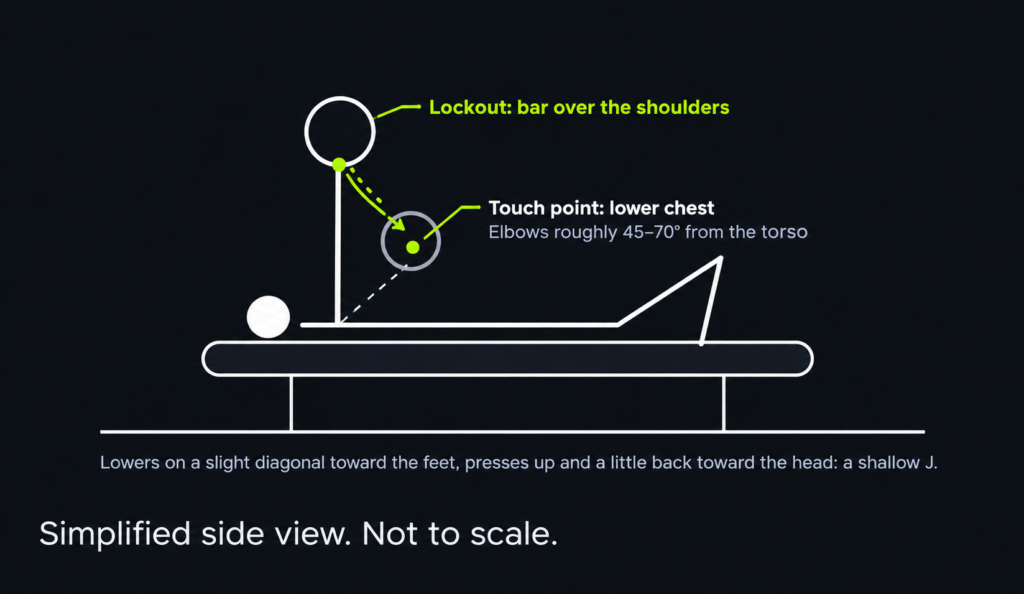
The bar does not travel in a straight vertical line. It lowers on a slight diagonal to the lower chest, then presses up and a little back toward your head so it finishes over your shoulders again.
The exact touch point depends on your arm length and grip, so use it as a guide rather than a rule. What matters is that it repeats. If the bar drifts toward your face or your feet from rep to rep, your estimate will drift with it.
Elbows tucked to roughly 45 to 70 degrees from the torso protect your shoulders and let the chest, triceps and shoulders share the work.
REP RANGES
Rep Ranges for the Bench Press
You can estimate a bench max from many rep counts, but not all of them are equally useful. Sets of 2 to 10 give the best estimates. Beyond that, fatigue and breathing start to matter more than strength.
1–5
STENGTH
Heavy and low-rep. The best fit for building maximal strength, and the sets that give the closest estimate of a true max.
5–8
BEST FOR ESTIMATING
Hard enough to reflect your strength, controlled enough to keep your technique identical across reps. A solid set of five is hard to beat.
8–12
SIZE AND VOLUME
Great for muscle and shoulder-friendly volume. Use it for training, but lean on lower-rep sets when you want an estimate.
COMMON MISTAKE
Bench Press Mistakes That Hold Numbers Back
These are the habits that cost lifters strength, or make a set harder to compare with the next one.
Flaring the elbows wide
Elbows pointing straight out to the sides load the shoulders hard and shorten the pressing power of your triceps.
Tuck them to about 45–70° and keep your forearms close to vertical.
Bouncing the bar off the chest
A bounce borrows momentum, so the set looks stronger than you are and the estimate comes out inflated.
Lower under control and touch lightly, or add a short pause.
Losing upper-back tightness
Shoulders that roll forward or a back that goes soft leaves you pressing from an unstable base.
Set your shoulder blades before unracking and keep them pinned.
Lifting the hips or feet
A bridge that shifts mid-rep changes the lift. It also makes comparing sets unreliable.
Keep your glutes down and your feet planted from first rep to last.
A wandering bar path
Pressing toward your face on one rep and your feet on the next wastes force and hides your real level.
Finish every rep over the shoulders and film a set from the side.
Skipping warm-up sets
Jumping straight to a heavy set gives a worse set, and the estimate you take from it will be too low.
Ramp up with progressively heavier sets. The calculator builds them for you.
Testing a True Bench Max
This calculator provides an estimate, not a guaranteed maximum. Use good technique, appropriate warm-ups, and sensible loads. If you test a true 1RM, use proper safety equipment and a spotter where appropriate. 1. Bench inside a power rack with safety bars set just below your chest. 2. Use a spotter you trust, and agree on signals before the attempt. 3. Collars on the bar, a good warm-up ramp, and no max attempts when you are tired or sore.
BENCH PRESS FAQ
Bench Press Questions, Answered
Quick answers on estimating and training your bench. The calculator does the maths; these cover the judgement calls.
How do I calculate my bench press 1RM?
Do a hard, controlled set of roughly 2 to 10 reps, enter the weight and reps into the calculator, and press Calculate. It averages several established formulas. For a closer estimate, note how many reps you had left using RPE or RIR.
What rep range gives the best bench estimate?
Sets of about three to eight reps tend to be the most repeatable. Very low reps are closest to a true max but harder to repeat; above ten, fatigue and breathing start to distort the estimate.
Should I use a touch-and-go or paused bench?
Either works as long as you are consistent. Paused reps remove the bounce, so they usually give a more conservative number. If you compete in paused benching, estimate from paused sets.
Can I use dumbbells?
Yes. Pick Dumbbell Bench Press in the variation menu and enter the weight of one dumbbell. Because dumbbells are less stable, estimates can run a little lower than a barbell number.
How accurate is a bench press 1RM estimate?
It is a useful guide, not a guarantee. Technique, rest, fatigue and how close to failure the set was all move it, and the formulas differ from each other by a few percent. Check it against how your heavier warm-up sets feel.
How often should I test or recalculate my bench max?
Recalculating from a hard set every three to six weeks is plenty for most lifters. True max attempts are heavy and tiring, so keep those rare and planned.
What is a training max and should I use it for bench?
A training max is a number slightly below your estimated 1RM, often around 90%, used to base programme percentages on. It leaves room to progress. You will find it in the results.
Check Your Other Lifts
Each calculator uses the same engine and the same formulas, set up for the lift in front of you.
Squat Max Calculator
Estimate your squat max without needing to test a true one-rep maximum every session.
Deadlift Calculator
Estimate your deadlift 1RM from a controlled working set and use the result to guide your training.
Any Exercise
Overhead press, rows, hip thrusts and 13 more lifts in one calculator, with the same percentages and warm-ups.
Know Your Bench. Plan Your Next Session.
Enter your last hard set and turn it into a bench max, working weights and warm-ups.