
- DEADLIFT
- 1RM
- PERCENTAGES
Deadlift 1RM Calculator
Enter a recent hard set of deadlifts and get your estimated deadlift max, with the percentages, rep maxes and warm-ups to plan your next pull. Built for lifters who want a working number without grinding out a true max, conventional or sumo.
Deadlift 1RM · estimated
144.4kg
≈ 318.3 lb
Consensus of 7 of 7 formulas · 125 kg × 5 reps
Lowest 140.6Highest 148.8 kg
Estimates only. Not medical or coaching advice.
Formula comparison
Seven published formulas convert a submaximal set into a 1RM estimate. They disagree a little, and that is useful: the consensus is the average of the formulas you keep ticked. Use the arrow on any row to see the maths with your own numbers.
| Formula | Estimate | vs. avg (difference from the consensus) | Show calculation |
|---|---|---|---|
| 145.8 kg | +1.0% | ||
Your numbers: Linear and slightly generous at higher reps. The most widely used formula. | |||
| 140.6 kg | −2.6% | ||
Your numbers: Tends to be conservative at low reps and climbs fast beyond 10 reps. | |||
| 146.8 kg | +1.7% | ||
Your numbers: Power-law curve. Gives higher estimates than most formulas at 2–6 reps. | |||
| 140.6 kg | −2.6% | ||
Your numbers: Simple linear model, usually among the lowest estimates. | |||
| 145.7 kg | +0.9% | ||
Your numbers: Exponential model fitted to rep-max data; close to Epley at moderate reps. | |||
| 148.8 kg | +3.0% | ||
Your numbers: Developed from bench press data in trained athletes; usually on the higher side. | |||
| 142.1 kg | −1.5% | ||
Your numbers: Linear in the denominator; behaves much like Brzycki at low reps. | |||
| Consensus (average of ticked) | 144.4 kg | ±2.8% | |
The formulas agree within 5.6% for this set.
1RM percentage table
Working weights from 50% to 100% of your estimated max, with the reps you could typically manage at each load.
| % of 1RM | Weight | Reps | Typical use |
|---|---|---|---|
| 100%Peaking / max attempts | 145 kg | ≈ 1 | Peaking / max attempts |
| 95%Peaking / max attempts | 137.5 kg | ≈ 2 | Peaking / max attempts |
| 90%Heavy strength work | 130 kg | ≈ 4 | Heavy strength work |
| 85%Heavy strength work | 122.5 kg | ≈ 6 | Heavy strength work |
| 80%Strength & power | 115 kg | ≈ 8 | Strength & power |
| 75%Strength & power | 107.5 kg | ≈ 11 | Strength & power |
| 70%Hypertrophy & volume | 100 kg | ≈ 14 | Hypertrophy & volume |
| 65%Hypertrophy & volume | 95 kg | ≈ 16 | Hypertrophy & volume |
| 60%Technique & speed | 87.5 kg | ≈ 19 | Technique & speed |
| 55%Technique & speed | 80 kg | ≈ 22 | Technique & speed |
| 50%Warm-up & recovery | 72.5 kg | ≈ 25 | Warm-up & recovery |
2RM–10RM estimates
The heaviest weight you could expect to lift for each rep count. Your own set is highlighted when it falls in this range.
| Rep max | Weight | % of 1RM |
|---|---|---|
| 1RM | 145 kg | 100% |
| 2RM | 135 kg | 94% |
| 3RM | 132.5 kg | 91% |
| 4RM | 127.5 kg | 89% |
| 5RMyour set | 125 kg | 87% |
| 6RM | 122.5 kg | 84% |
| 7RM | 117.5 kg | 82% |
| 8RM | 115 kg | 80% |
| 9RM | 112.5 kg | 78% |
| 10RM | 110 kg | 76% |
Training max
Many programmes (5/3/1 for example) base their percentages on a training max slightly below your true max, so every session leaves room to progress.
130 kg
90% of your estimated 1RM of 144.4 kg
- Base programme percentages on this number, not your true max.
- Re-test or re-calculate every 4–8 weeks and move it up when sets feel easy.
- A lower percentage (80–85%) suits beginners or high-volume blocks.
Warm-up sets
A simple ramp that builds to your target without tiring you out. Pick the top set you are warming up for.
| Set | Weight | Reps | % of 1RM |
|---|---|---|---|
| Empty bar | 20 kg | 10 | 14% |
| Warm-up 1 | 57.5 kg | 5 | 40% |
| Warm-up 2 | 87.5 kg | 3 | 61% |
| Warm-up 3 | 110 kg | 2 | 76% |
| Warm-up 4 | 127.5 kg | 1 | 88% |
| Max attempt | 145 kg | 1 | 100% |
Rest 1–2 minutes between warm-up sets and 3+ minutes before the top set.
DEADLIFT PERCENTAGE
Deadlift Percentages and Training Loads
The deadlift is demanding on recovery, so percentages matter even more than for other lifts. Here is how lifters commonly use each band. Treat them as starting points.
The weights use a 400 lb example. Press Calculate above to get yours, with a warm-up ramp for your target set.
Example for a 400 lb deadlift 1RM
% of 1RM
WEIGHT MAX REPS
HOW IT IS USED
380 lb ≈ 2
Heavy singles. Use rarely; deadlifts are hard to recover from.
360 lb ≈ 4
Heavy doubles, with a reset between reps.
340 lb ≈ 6
Strength sets of 2 to 5 reps.
320 lb ≈ 8
Main strength work: sets of 3 to 5, dead-stop.
300 lb ≈ 11
Volume work in the 5 to 6 rep range.
280 lb ≈ 14
Technique, speed and paused or deficit variations.
260 lb ≈ 16
Speed pulls and back-off sets.
240 lb ≈ 19
Warm-ups, technique and light days.
Weights are rounded examples. Working sets are normally stopped well short of failure.
STARTING POSITION
Get the Start Right
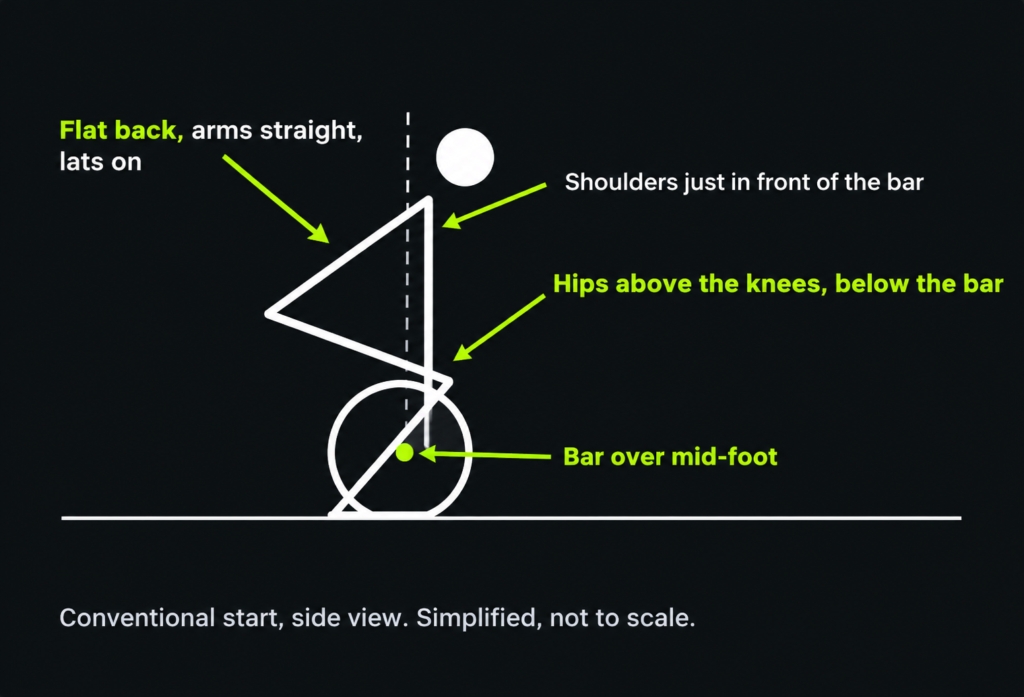
The deadlift is won or lost before the bar leaves the floor. A repeatable start is also what makes a set comparable with the next one.
Bar over mid-foot. Stand so the bar sits above the middle of your foot, with your shins close to it but not pressing into it.
Hips in the middle. Hinge, grip the bar, then drop your hips until they sit above your knees and below your shoulders. They are not a squat and not a stiff-leg start.
Take the slack out. Pull until you feel the bar firm against the plates, squeeze your armpits as if holding oranges under them, and keep your arms straight. Then push the floor away.
BRACING AND LOCKOUT
Brace Before You Pull, Finish Tall
Two moments decide most deadlifts: the breath before the bar moves, and the lockout at the top.
Breathe and brace
Inhale into your belly, tighten your abs around the air and keep your ribs down. Hold that pressure for the whole rep.
Push the floor away
Think of leg-pressing the floor rather than yanking the bar. Keep the bar close, dragging it up your legs.
Lock out together
Hips and knees finish at the same time. Squeeze your glutes and stand tall. Do not lean back or shrug at the top.
Set it down under control
Reverse the movement and lower the bar deliberately. Reset your brace before the next rep.
Choose a grip you trust
A mixed grip or hook grip handles heavy sets. Straps are fine for training if your grip limits your back and legs.
Use dead-stop reps for estimates
Letting the bar settle between reps gives a more consistent set than touch-and-go, and a more reliable calculation.
REP RANGES
Which Rep Range Works Best for the Deadlift?
You can estimate a deadlift max from sets of about 2 to 10 reps. In practice, many lifters find lower rep sets more repeatable on the deadlift, because grip and fatigue creep in sooner than on other lifts.
1–3
HEAVY
Close to a true max. Great for the closest estimate, but heavy and tiring, so use sparingly.
3–6
BEST FOR ESTIMATING
Heavy enough to reflect your strength and still controllable. Dead-stop each rep for the cleanest number.
6–10
VOLUME
Useful for training. Grip and back fatigue often limit these sets, so the estimate can read low.
COMMON MISTAKE
Deadlift Mistakes That Cost You Pounds
Most deadlift problems are start-position problems. These are the ones to look for first.
Hips shooting up first
The legs straighten before the bar moves, so the back does all the work and the pull stalls.
Push the floor away and keep your chest and hips rising together.
The bar drifting away from you
A bar that swings forward makes the lift longer and much harder.
Start with the bar over mid-foot and keep it brushing your legs.
Jerking the bar off the floor
Yanking skips the tension and can make your back round as the weight breaks the floor.
Take the slack out first, then pull smoothly.
Rounding the back under load
A back that folds as the bar leaves the floor shows a loss of brace or a weight that is too heavy for the day.
Brace harder, set the lats, and lower the load to what you can hold.
Leaning back at lockout
Throwing the shoulders behind the hips adds stress to the lower back and does not count as a better finish.
Squeeze the glutes and stand tall, with the hips and knees finishing together.
Skipping the reset between reps
Bouncing reps blur the lift and give you an inflated estimate.
Let the plates settle, re-brace and start each rep from a fresh position.
Testing a True Deadlift Max
This calculator provides an estimate, not a guaranteed maximum. Use good technique, appropriate warm-ups, and sensible loads. If you test a true 1RM, use proper safety equipment and a spotter where appropriate. 1. Lift on a surface that will not slip, with shoes or socks that grip it. 2. Do not test a max with a rounded back. If your position breaks down, the set is over. 3. Use collars, ramp up with warm-ups, and give yourself recovery time after a heavy pull.
DEADLIFT FAQ
Deadlift Questions, Answered
Conventional, sumo and how to get a number you can trust.
How do I calculate my deadlift 1RM?
Do a hard, controlled set of roughly 2 to 6 reps, enter the weight and reps and press Calculate. The result averages several established formulas. If you stopped with reps left, add RPE or RIR.
Can I use the calculator for sumo deadlifts?
Yes. Pick Sumo Deadlift from the variation menu and enter sets from that style only. Conventional and sumo maxes differ, so keep them separate.
Should I use dead-stop or touch-and-go reps?
Dead-stop reps give a more consistent set, because you restart from the floor every time. Touch-and-go can let momentum creep in, which tends to inflate an estimate.
Why are high-rep deadlift estimates less reliable?
On higher reps, grip, breathing and fatigue limit the set as much as raw strength, so the formulas drift further from the truth. Lower reps give a steadier estimate.
Does using a mixed grip, hook grip or straps change the result?
It can. If you plan to train with a mixed grip, estimate from a mixed-grip set. Straps often add a few reps on sets that are limited by your grip.
What about Romanian deadlifts?
The calculator includes them. Enter a Romanian deadlift set to estimate that lift’s max. It is a different number from your floor deadlift, so do not compare the two directly.
How do I use deadlift percentages in training?
Use lighter loads for technique and speed, mid-range loads for the bulk of your strength work and heavy loads sparingly. The results table lists your weights from 50% to 100%.
Check Your Other Lifts
Each calculator uses the same engine and the same formulas, set up for the lift in front of you.
Bench Press Calculator
Estimate your bench press 1RM from a recent set and use it to plan practical training weights.
Squat Max Calculator
Estimate your squat max without needing to test a true one-rep maximum every session.
Any Exercise
Overhead press, rows, hip thrusts and 13 more lifts in one calculator, with the same percentages and warm-ups.
Know Your Deadlift. Plan the Next Pull.
Enter your last hard set and turn it into a deadlift max, working weights and a warm-up ramp.