
- SQUAT
- 1RM
- PERCENTAGES
Squat 1RM Calculator
Enter a recent hard set of squats and get your estimated squat max, with the percentages, rep maxes and warm-ups to build your next session. Built for lifters who train the squat and want a working number without testing a true max every cycle.
Back Squat 1RM · estimated
115.5kg
≈ 254.6 lb
Consensus of 7 of 7 formulas · 100 kg × 5 reps
Lowest 112.5Highest 119 kg
Estimates only. Not medical or coaching advice.
Formula comparison
Seven published formulas convert a submaximal set into a 1RM estimate. They disagree a little, and that is useful: the consensus is the average of the formulas you keep ticked. Use the arrow on any row to see the maths with your own numbers.
| Formula | Estimate | vs. avg (difference from the consensus) | Show calculation |
|---|---|---|---|
| 116.7 kg | +1.0% | ||
Your numbers: Linear and slightly generous at higher reps. The most widely used formula. | |||
| 112.5 kg | −2.6% | ||
Your numbers: Tends to be conservative at low reps and climbs fast beyond 10 reps. | |||
| 117.5 kg | +1.7% | ||
Your numbers: Power-law curve. Gives higher estimates than most formulas at 2–6 reps. | |||
| 112.5 kg | −2.6% | ||
Your numbers: Simple linear model, usually among the lowest estimates. | |||
| 116.6 kg | +0.9% | ||
Your numbers: Exponential model fitted to rep-max data; close to Epley at moderate reps. | |||
| 119 kg | +3.0% | ||
Your numbers: Developed from bench press data in trained athletes; usually on the higher side. | |||
| 113.7 kg | −1.5% | ||
Your numbers: Linear in the denominator; behaves much like Brzycki at low reps. | |||
| Consensus (average of ticked) | 115.5 kg | ±2.8% | |
The formulas agree within 5.6% for this set.
1RM percentage table
Working weights from 50% to 100% of your estimated max, with the reps you could typically manage at each load.
| % of 1RM | Weight | Reps | Typical use |
|---|---|---|---|
| 100%Peaking / max attempts | 115 kg | ≈ 1 | Peaking / max attempts |
| 95%Peaking / max attempts | 110 kg | ≈ 2 | Peaking / max attempts |
| 90%Heavy strength work | 105 kg | ≈ 4 | Heavy strength work |
| 85%Heavy strength work | 97.5 kg | ≈ 6 | Heavy strength work |
| 80%Strength & power | 92.5 kg | ≈ 8 | Strength & power |
| 75%Strength & power | 87.5 kg | ≈ 11 | Strength & power |
| 70%Hypertrophy & volume | 80 kg | ≈ 14 | Hypertrophy & volume |
| 65%Hypertrophy & volume | 75 kg | ≈ 16 | Hypertrophy & volume |
| 60%Technique & speed | 70 kg | ≈ 19 | Technique & speed |
| 55%Technique & speed | 62.5 kg | ≈ 22 | Technique & speed |
| 50%Warm-up & recovery | 57.5 kg | ≈ 25 | Warm-up & recovery |
2RM–10RM estimates
The heaviest weight you could expect to lift for each rep count. Your own set is highlighted when it falls in this range.
| Rep max | Weight | % of 1RM |
|---|---|---|
| 1RM | 115 kg | 100% |
| 2RM | 110 kg | 94% |
| 3RM | 105 kg | 91% |
| 4RM | 102.5 kg | 89% |
| 5RMyour set | 100 kg | 87% |
| 6RM | 97.5 kg | 84% |
| 7RM | 95 kg | 82% |
| 8RM | 92.5 kg | 80% |
| 9RM | 90 kg | 78% |
| 10RM | 87.5 kg | 76% |
Training max
Many programmes (5/3/1 for example) base their percentages on a training max slightly below your true max, so every session leaves room to progress.
105 kg
90% of your estimated 1RM of 115.5 kg
- Base programme percentages on this number, not your true max.
- Re-test or re-calculate every 4–8 weeks and move it up when sets feel easy.
- A lower percentage (80–85%) suits beginners or high-volume blocks.
Warm-up sets
A simple ramp that builds to your target without tiring you out. Pick the top set you are warming up for.
| Set | Weight | Reps | % of 1RM |
|---|---|---|---|
| Empty bar | 20 kg | 10 | 17% |
| Warm-up 1 | 45 kg | 5 | 39% |
| Warm-up 2 | 70 kg | 3 | 61% |
| Warm-up 3 | 87.5 kg | 2 | 76% |
| Warm-up 4 | 100 kg | 1 | 87% |
| Max attempt | 115 kg | 1 | 100% |
Rest 1–2 minutes between warm-up sets and 3+ minutes before the top set.
SQUAT PERCENTAGE
Squat Percentages and What They Are Used For
Squat programmes are built from percentages of your max, so a believable 1RM matters. Here is how lifters commonly use each load. They are starting points, not rules.
The weights use a 300 lb example. Press Calculate above to see yours, including a warm-up ramp to your top set.
Example for a 300 lb squat 1RM
% of 1RM
WEIGHT MAX REPS
HOW IT IS USED
285 lb ≈ 2
Heavy singles. Peaking blocks only, with safeties or a spotter.
270 lb ≈ 4
Heavy doubles and triples with a strong brace every rep.
255 lb ≈ 6
Top sets of 3 to 5, leaving a rep or two in reserve.
240 lb ≈ 8
Core strength work: sets of 4 to 6.
225 lb ≈ 11
Volume strength, such as 5 sets of 5.
210 lb ≈ 14
Moderate volume and paused squats for depth practice.
195 lb ≈ 16
Speed work, technique and back-off sets.
180 lb ≈ 19
Warm-ups, tempo squats and light days.
Weights are rounded examples. Working sets are normally stopped well short of failure.
BRACING
Bracing: The Part Most People Skip
Your brace is what turns leg strength into a stable lift. Without it, the bar moves your torso instead of you moving the bar.
Breathe low and wide
Inhale into your belly and sides, not your chest. Think of filling a barrel around your midsection, front, sides and back.
Tighten around the air
Tense your abs as if someone were about to poke your stomach, and keep that pressure. Your ribs stay stacked over your pelvis.
Hold it, then reset
Keep the brace through the descent and the drive out of the hole. Take a fresh breath and re-brace at the top of every rep.
DEPTH
How Deep Should You Squat?
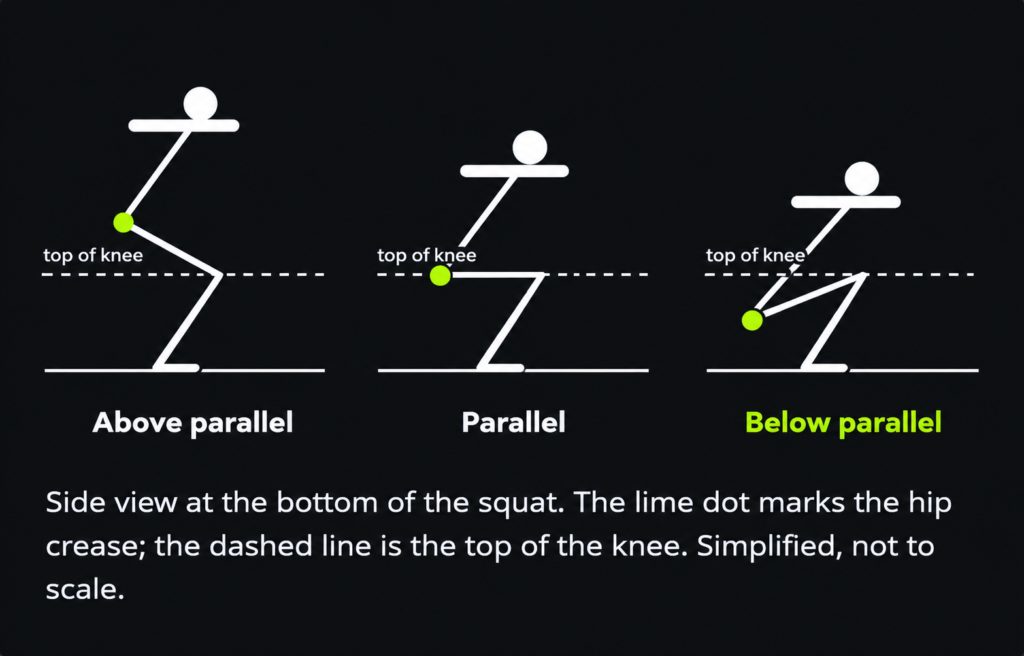
For a number you can trust, pick one depth and hit it every rep. A set that gets shallower as it gets harder will overstate your max.
In powerlifting, the crease of the hip has to travel below the top of the knee. That is a sensible standard for training too, although your hips, proportions and goals may favour a slightly different depth. If you are not competing, choose the deepest position you can reach with a flat, controlled back and keep it consistent.
If you are not sure where you land, film a set from the side or squat to a box set at your target depth.
FOOT POSITION
Stance and Foot Position
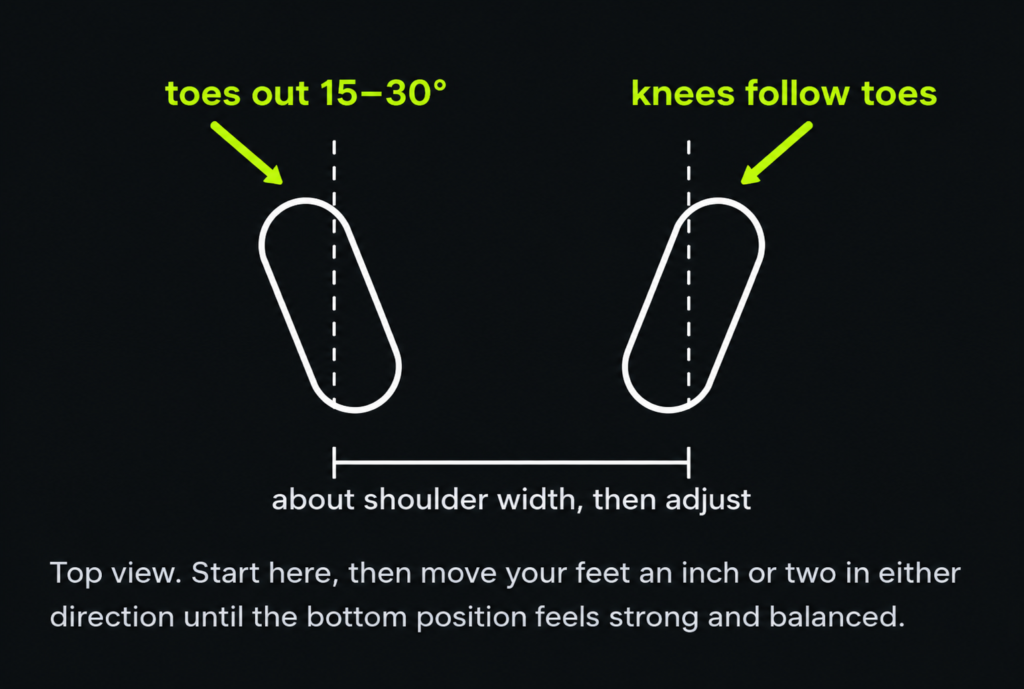
A good starting stance is about shoulder width, with your toes turned out roughly 15 to 30 degrees. Your knees should follow the line of your toes as you descend.
There is no perfect stance. Hip structure, ankle mobility and limb length all change what works, so run a few warm-up sets at slightly different widths and keep the one that feels strongest.
Keep your whole foot on the floor. If your heels lift, you are either short on ankle mobility or leaning too far forward. Lifting shoes or small plates under your heels can help.
COMMON MISTAKES
Squat Mistakes That Skew Your Max
Some of these cost you strength. Others quietly change the lift between sets and make an estimate unreliable.
Cutting depth when it gets heavy
Each rep ends a little higher than the last, so the final reps look easier than they are.
Set your depth in the warm-ups and stick to it. A box or camera helps.
Knees collapsing inward
The knees cave in as you drive up, which wastes force and stresses the joint.
Push the knees out over your toes and screw your feet into the floor.
Heels lifting off the floor
Your weight shifts to your toes and the bar drifts forward.
Keep your whole foot planted. Check mobility or try lifting shoes.
Turning the squat into a good morning
Your hips shoot up first and your chest drops, so the back does the work instead of the legs.
Think chest and hips rising together. Slow your first reps down.
Losing the brace in the hole
Air leaks out, the torso softens and the bar slows or folds you forward.
Take a bigger breath before descending and hold it until you pass the sticking point.
Unracking sloppily
Walking out in too many steps wastes energy before the rep starts.
Set your upper back, stand up with the bar, take two or three steps and set your stance.
Testing a True Squat Max
This calculator provides an estimate, not a guaranteed maximum. Use good technique, appropriate warm-ups, and sensible loads. If you test a true 1RM, use proper safety equipment and a spotter where appropriate. 1. Squat in a power rack with safety bars set just below your bottom position. 2. Learn how to bail safely before you ever need to, and never squat a max alone without safeties. 3. Use a full warm-up ramp and skip max attempts on days you are fatigued.
SQUAT FAQ
Squat Questions, Answered
Depth, bracing and what to enter into the calculator. Quick answers from a lifter’s point of view.
How do I calculate my squat 1RM?
Do a hard set of 2 to 10 reps at your normal depth, enter the weight and reps, and press Calculate. The result averages several established formulas. If you stopped short of failure, add RPE or RIR.
Is the calculator for back squats or front squats?
Both. Pick Squat, Front Squat or Leg Press from the variation menu. Each lift has its own max, so enter a set from the lift you want to estimate.
Does depth affect my estimate?
A lot. The formulas assume every rep was done the same way, so a set where depth got shallower will overestimate your max. Use a depth you can hit on every rep.
What rep range is best for estimating a squat max?
Sets of roughly three to eight are usually the most repeatable. A single or double is nearer a true max, while sets past ten are limited by fatigue and breathing as much as leg strength.
Should I include a belt, wraps or sleeves?
Use the same equipment for the set you enter and the lifts you plan to train. If you squat in a belt, estimate from a belted set so the number matches how you train.
Why does my calculated max feel too high or low?
Estimates are only as good as the set you enter. Fatigue, shaky depth, a missed brace or a set far from failure all change the result. Check it against a heavy warm-up single.
How often should I recalculate my squat max?
Every three to six weeks works for most lifters, using a fresh hard set. Heavy squats are demanding, so avoid testing a true max too often.
Check Your Other Lifts
Each calculator uses the same engine and the same formulas, set up for the lift in front of you.
Bench Press Calculator
Estimate your bench press 1RM from a recent set and use it to plan practical training weights.
Deadlift Calculator
Estimate your deadlift 1RM from a controlled working set and use the result to guide your training.
Any Exercise
Overhead press, rows, hip thrusts and 13 more lifts in one calculator, with the same percentages and warm-ups.
Know Your Squat. Build the Next Cycle.
Enter your last hard set and turn it into a squat max, working weights and a warm-up ramp.